BIAB nails have become one of the most booked nail services in the UK, yet many people still book them without being sure what BIAB is. This guide explains what BIAB nails mean, how it differs from gel polish and acrylics, what UK salons publish for new sets and infills, how often you need to go back, and what dermatologists say about removal and allergy.
Quick answer: BIAB stands for Builder In A Bottle, a builder gel made by The Gel Bottle. It’s brushed over your natural nails as a strengthening overlay and cured under a lamp. It’s usually maintained with infills rather than removed each time. It suits people growing their natural nails rather than adding long extensions.
One thing to know first: BIAB is a brand name, and in everyday use “BIAB” is often used loosely for any builder gel. The Gel Bottle describes itself as the inventor of BIAB™, and the name is a trademark. Salons may offer BIAB nails from The Gel Bottle or a similar builder gel from another brand under the same menu name, so it is worth asking which product is being used. This page uses British English and UK prices throughout.
What BIAB nails are (and why the name matters)
According to The Gel Bottle’s product page, BIAB™ is a builder gel for creating overlays and strengthening the natural nail. The company describes the Original formula as self-levelling, which means it settles smoothly on the nail as it is applied. The Gel Bottle also makes several other BIAB formulas, including fibre, hard and “TPO and HEMA-free” versions.
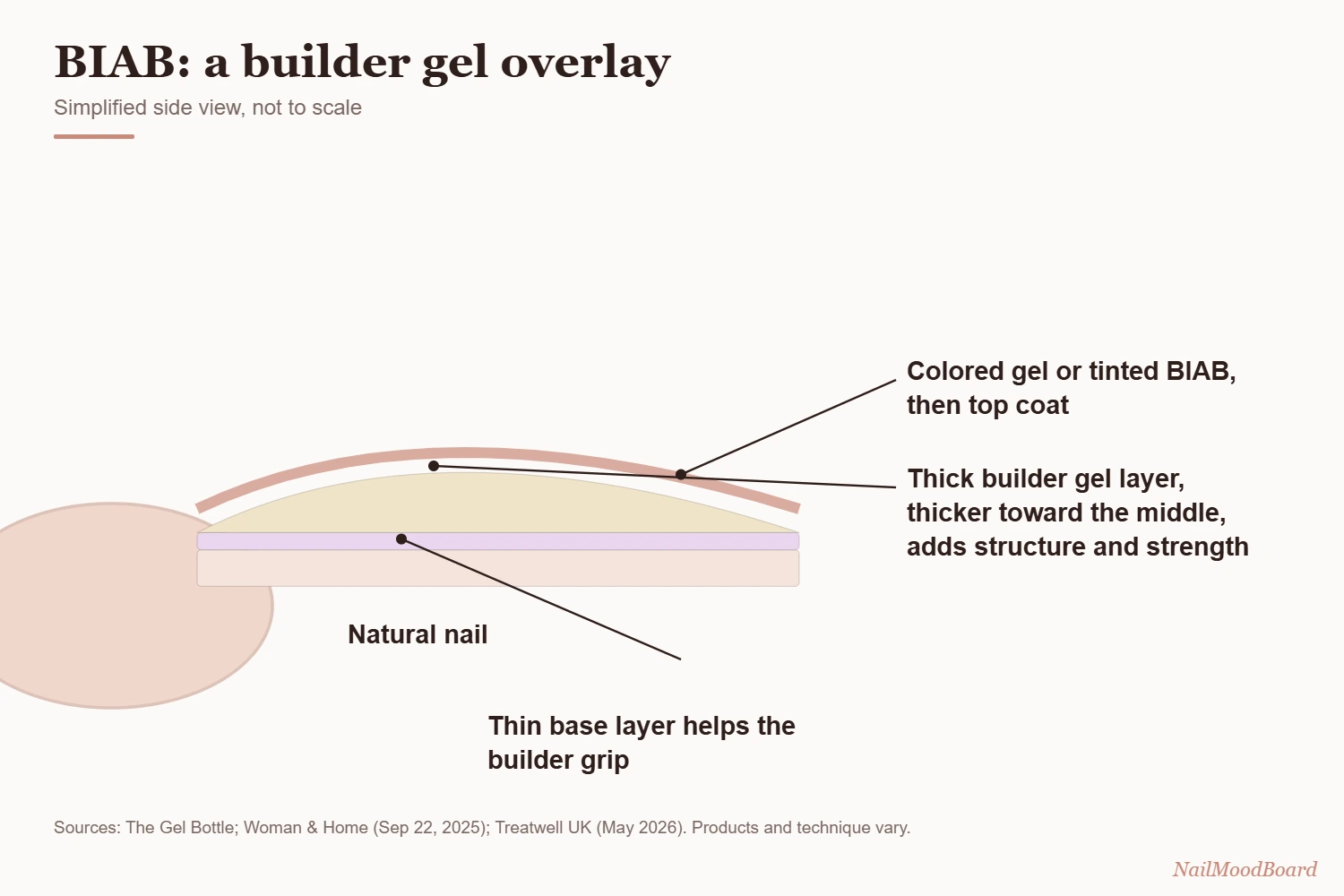
A builder gel is a thicker gel than normal gel polish. Brushed on in a layer, it forms a firm overlay that supports the natural nail. Beauty publications describe standard BIAB nails as a soak-off gel that is harder than regular gel polish, and as a product with a built-in structure that spreads pressure across the nail, which is why it is often chosen to help nails grow. A “hard” BIAB formula also exists, and it does not soak off. It has to be filed away.
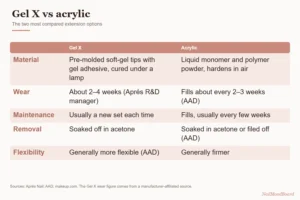
BIAB nails are a type of builder gel, but builder gel is not only BIAB. For how builder gel compares with tip-based extensions, see our builder gel vs Gel X guide.
BIAB nails vs gel polish vs acrylics
The three services do different jobs. Gel polish adds colour. BIAB nails add colour and structure to your own nail. Acrylic builds length and structure. Treatwell, a UK booking platform, summarises it as gel polish being cosmetic and BIAB nails adding structural support.
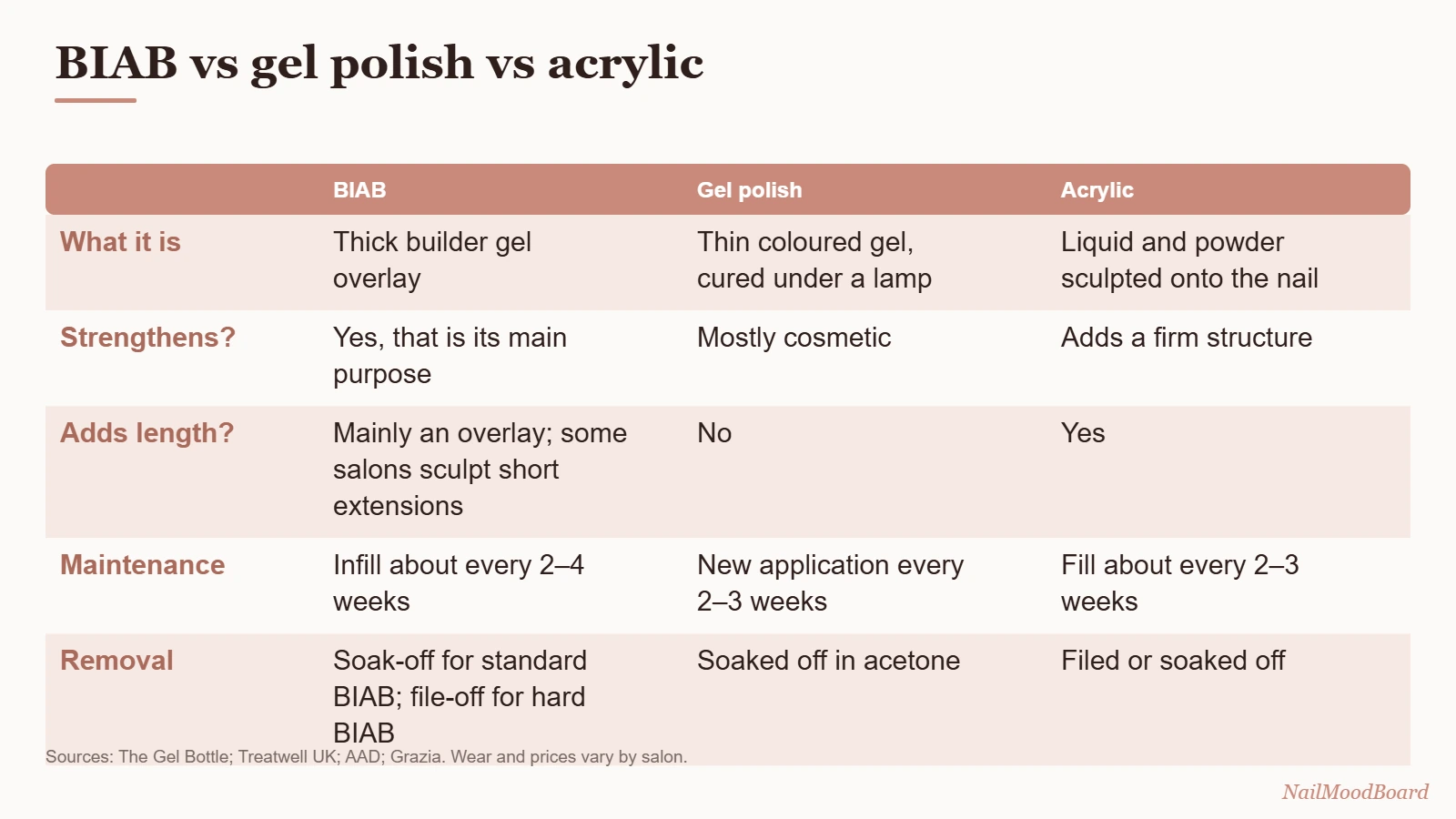
| BIAB | Gel polish | Acrylic | |
|---|---|---|---|
| What it is | Thick builder gel overlay | Thin coloured gel, cured under a lamp | Liquid and powder sculpted onto the nail |
| Strengthens nails? | Yes, that is its main purpose | Mostly cosmetic | Adds a firm structure |
| Adds length? | Mainly an overlay; some salons sculpt short extensions | No | Yes |
| Maintenance | Infill about every 2–4 weeks | New application every 2–3 weeks | Fill about every 2–3 weeks |
| Removal | Soak-off for standard BIAB nails; file-off for hard BIAB nails | Soaked off in acetone | Filed or soaked off |
| Typical UK price | £33 to £50 for a new set; £30 to £45 for an infill (salons checked) | £26 to £35 (salons checked) | Varies widely by city; published guides give roughly £30 to £90 for a full set |
| Best for | Growing and protecting natural nails | Colour and shine | Length and structure |
For a wider look at gel, dip and acrylic as a group, see our gel vs dip vs acrylic guide, and for the appointment itself, our gel manicure guide.
How a BIAB appointment works
Steps differ between salons, so treat this as an overview of the service, not instructions to try at home.
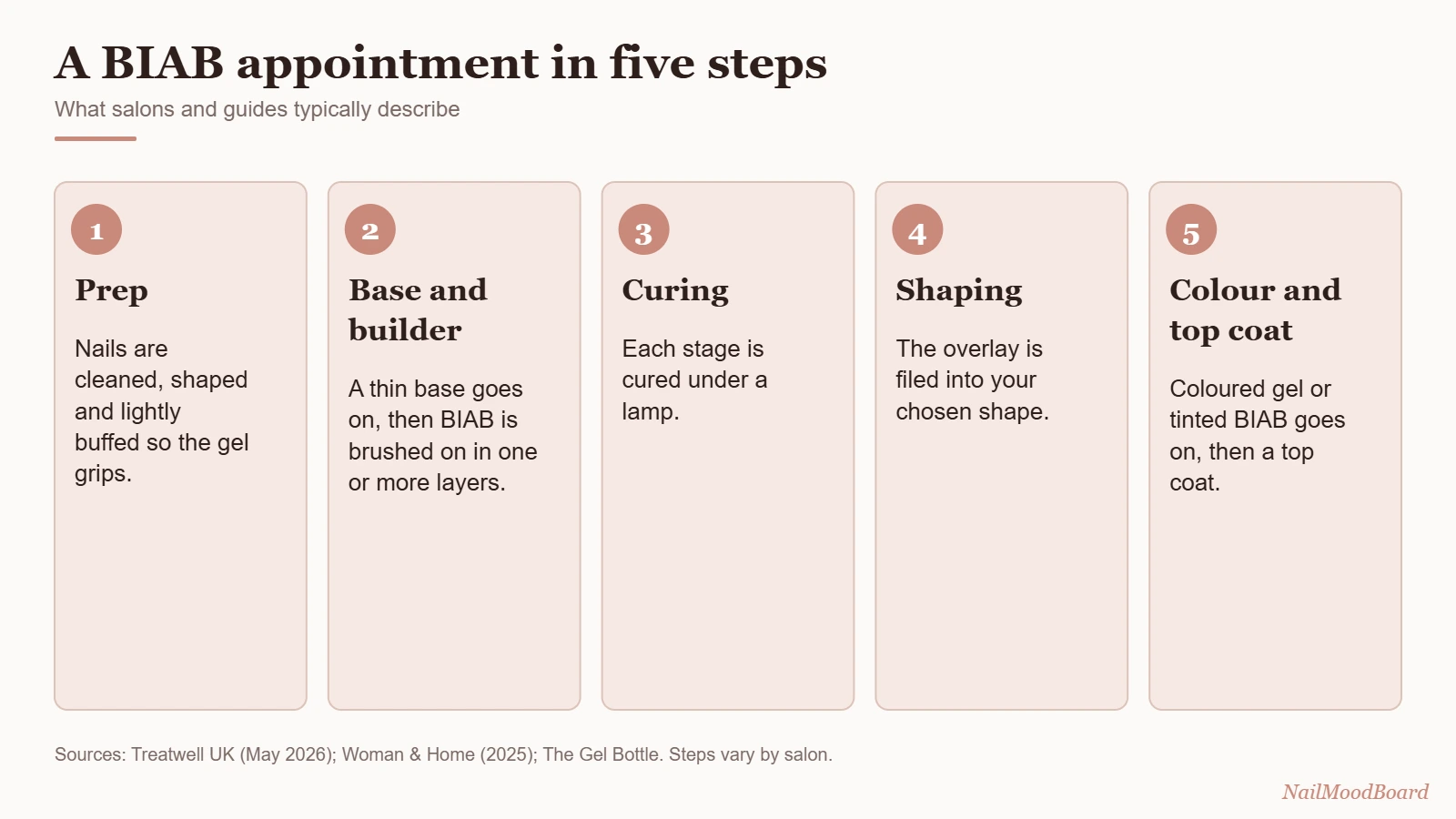
- Prep. Your nails are cleaned, shaped and lightly buffed so the gel grips. The American Academy of Dermatology (AAD) advises that cuticles should not be pushed or cut, so ask your tech to skip that step.
- Base and builder layer. A thin base is applied, then the BIAB is brushed on in one or more layers and often built slightly thicker toward the middle of the nail for support.
- Curing. Each stage is cured under a lamp.
- Shaping. The overlay is filed into your chosen shape. If you are unsure, our nail shapes guide compares the options.
- Colour and top coat. A coloured gel polish or a tinted BIAB goes on, followed by a top coat.
A new set generally takes around 45 minutes to an hour on salon menus, and an infill can take as long or longer. Nova Nails in Glasgow, for example, lists a new set at one hour and an infill at an hour and a half.
How long BIAB lasts, and infills
The Gel Bottle’s own BIAB page does not state a wear time or infill schedule, so no manufacturer figure is given here. What can be cited is published salon and publication guidance, and it is not completely consistent:
- Woman and Home (updated September 2025) says BIAB can last up to four weeks and recommends infills every three to four weeks.
- Treatwell (May 2026) says BIAB lasts three to four weeks, with most clients booking infills every two to three weeks as regrowth shows at the cuticle.
- The Nail Bar London in Kingston recommends infills every three to four weeks and says waiting longer than four weeks raises the risk of damage.
- SheerLuxe (November 2025) says it can stay chip-free for three weeks or more.
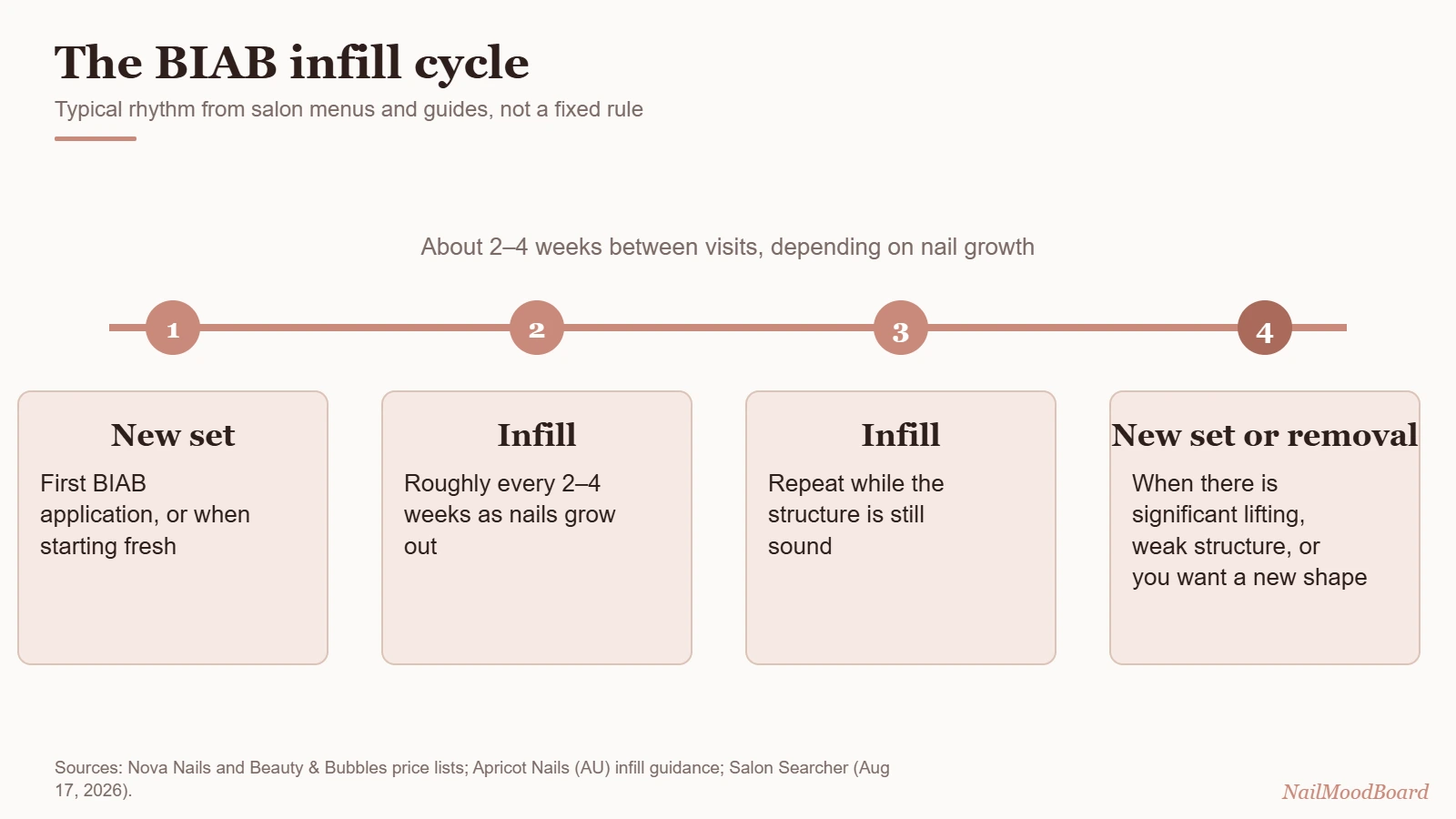
Salon menus and guides suggest an infill appointment roughly every two to four weeks, depending on how fast your nails grow and how you use your hands.
Infill or new set?
An infill refills the gap at the cuticle as your nail grows out. The tech files away the old colour and part of the existing BIAB, preps the new growth, and applies fresh product that blends into the old layers. A new set is usually needed when there is significant lifting, when the structure has weakened, when you want a different shape, or the first time you try BIAB. An Australian salon guide, Apricot Nails, makes the same point, and notes that infills avoid repeated full removals.
BIAB prices in the UK
Prices depend heavily on the city, the salon and the tech. To keep this transparent, the table below shows ranges from published salon price lists checked on 3 October 2026, and the figures are shown from the lowest listed price.
| Service | Price range | Salons checked | Date checked |
|---|---|---|---|
| New set on natural nails | £33 to £50 (middle value: £43) | 5 | 3 October 2026 |
| Infill | £30 to £45 (middle value: £37) | 6 | 3 October 2026 |
| Removal | £16 to £20 | 2 | 3 October 2026 |
The salons behind those ranges, with the prices as published:
- Viet Nail Studio, Aberdeen: BIAB on natural nail from £33, infill from £30.
- Nova Nails, Glasgow: new set £37, infill £45.
- Beauty and Bubbles, Manchester: full set £43, infill £39, full removal £16.
- UK Nails Ealing, London: BIAB French tip £45, infill £33.
- The Beauty Nest, London NW3: BIAB manicure £50, infill £42 (£47 with gel colour).
- The Nail Bar London, Kingston: infill £35, BIAB extensions £50 (extensions are not included in the new-set range above).
- Paint Nails London: BIAB removal £20 when booked with a service.
These sit inside the ranges that UK guides publish. Treatwell’s May 2026 guide gives £35 to £60 for full sets, with central London at the higher end, and Salon Searcher’s August 2026 price guide gives £35 to £60 for full sets and £30 to £45 for infills. Several of the salon pages above show no date, so confirm the current price before you book. Because this is a small sample, no single price here represents the whole country. Regional salons are often cheaper than London.
Who BIAB suits, and who it doesn’t
BIAB is commonly recommended for people who want to grow their natural nails, whose nails are soft, thin or prone to breaking, or who pick or bite their nails and want a firmer surface. SheerLuxe notes that it is often chosen for nails that peel or break easily and for people with demanding daily routines.
It is a weaker fit if you want long, dramatic extensions, because acrylic or hard gel is generally better for very long structured nails. It is also worth pausing if you have had a reaction to nail products before. UK dermatologists have warned about rising allergy to methacrylates in nail products, and the British Association of Dermatologists notes that under-cured product and skin contact raise the risk. HEMA-free BIAB lines exist, but that warning covers methacrylates in general, so a HEMA-free label does not make a product allergy-free.
Do BIAB nails damage your natural nails?
No overlay comes with a guarantee of zero damage. According to dermatology guidance, damage is most often linked to picking, over-filing and improper removal. Treatwell’s guide makes the same point for BIAB, saying the damage people associate with it almost always comes from picking it off or over-buffing during prep. The AAD also warns that frequent touch-ups can seriously damage natural nails, and advises breaks of one to two weeks between artificial nail services.
Publications such as Woman and Home describe BIAB as designed to strengthen rather than harm nails, but that is how it is positioned, not the result of an independent test. Treat it as a reasonable expectation when it is applied and removed correctly, not a promise.
If you notice redness, itching or swelling around the nails, stop and see a doctor or dermatologist.
How BIAB nails are removed
This is an overview, not a step-by-step instruction. Published salon and publication guidance describes the professional process as filing down the top layers, soaking the nails in acetone with foil wraps, and gently scraping the softened gel away, followed by moisturising. Treatwell describes the at-home version as lightly buffing the top layer, wrapping each nail in acetone-soaked cotton and foil for 10 to 15 minutes, then pushing the softened gel off with a wooden stick. Hard BIAB does not soak off and needs to be filed away.
Some nail techs and guides suggest professional removal for BIAB, because over-buffing and forcing product off are the usual causes of damage. UK salons commonly charge about £16 to £20 for it, based on the price lists above. If you do soak at home, the AAD advises soaking only the fingertips in acetone and never picking the gel off.
Aftercare
- Cuticle oil. Treatwell calls daily cuticle oil the single most important aftercare step.
- Do not pick or peel. The AAD says not to pick off gel.
- Leave cuticles alone. The AAD advises against cutting or pushing them, because they protect against infection.
- Protect your hands. Wear gloves for washing up and cleaning.
- Book your infill on time. Waiting too long can increase lifting and the strain on the nail.
BIAB nails colours and design ideas
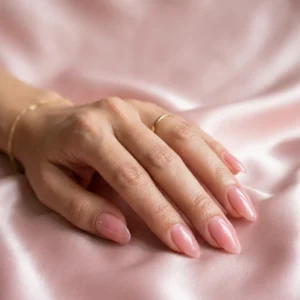
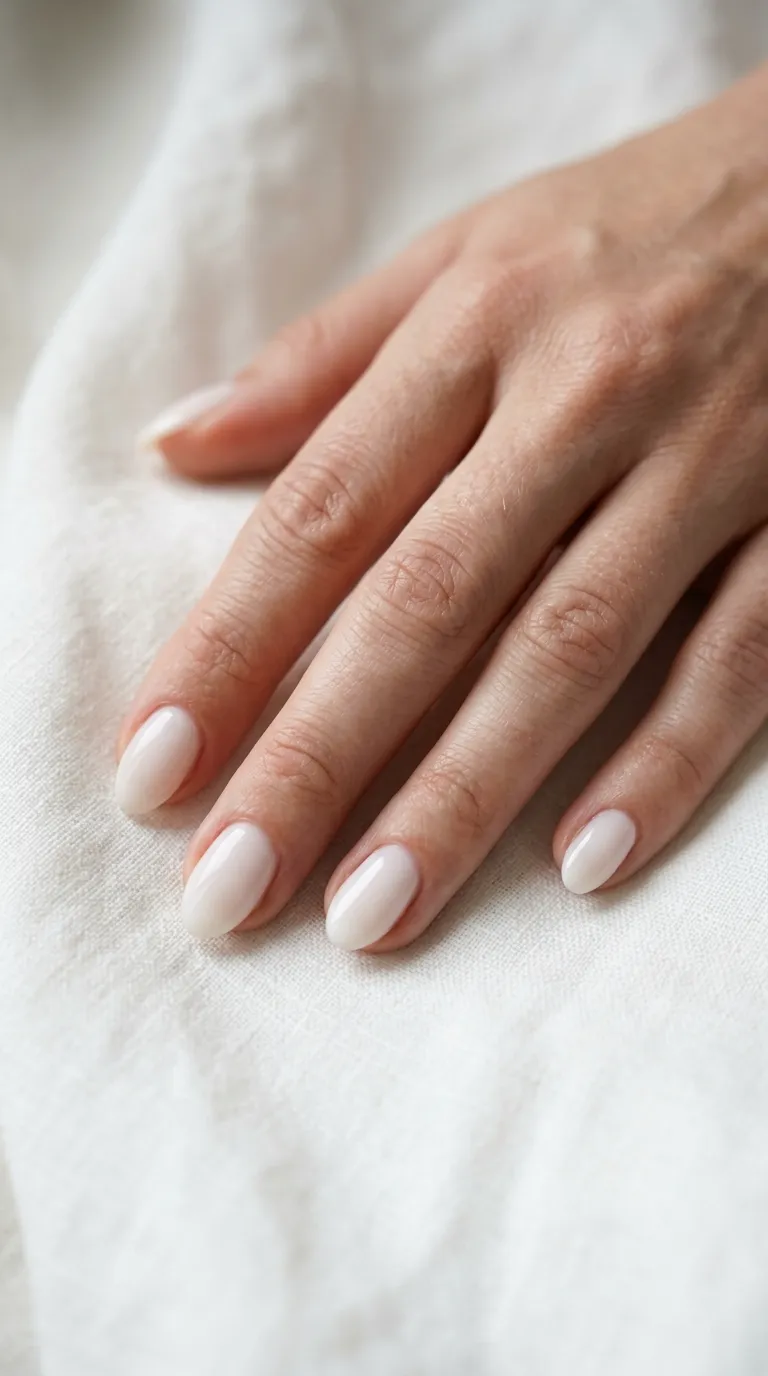
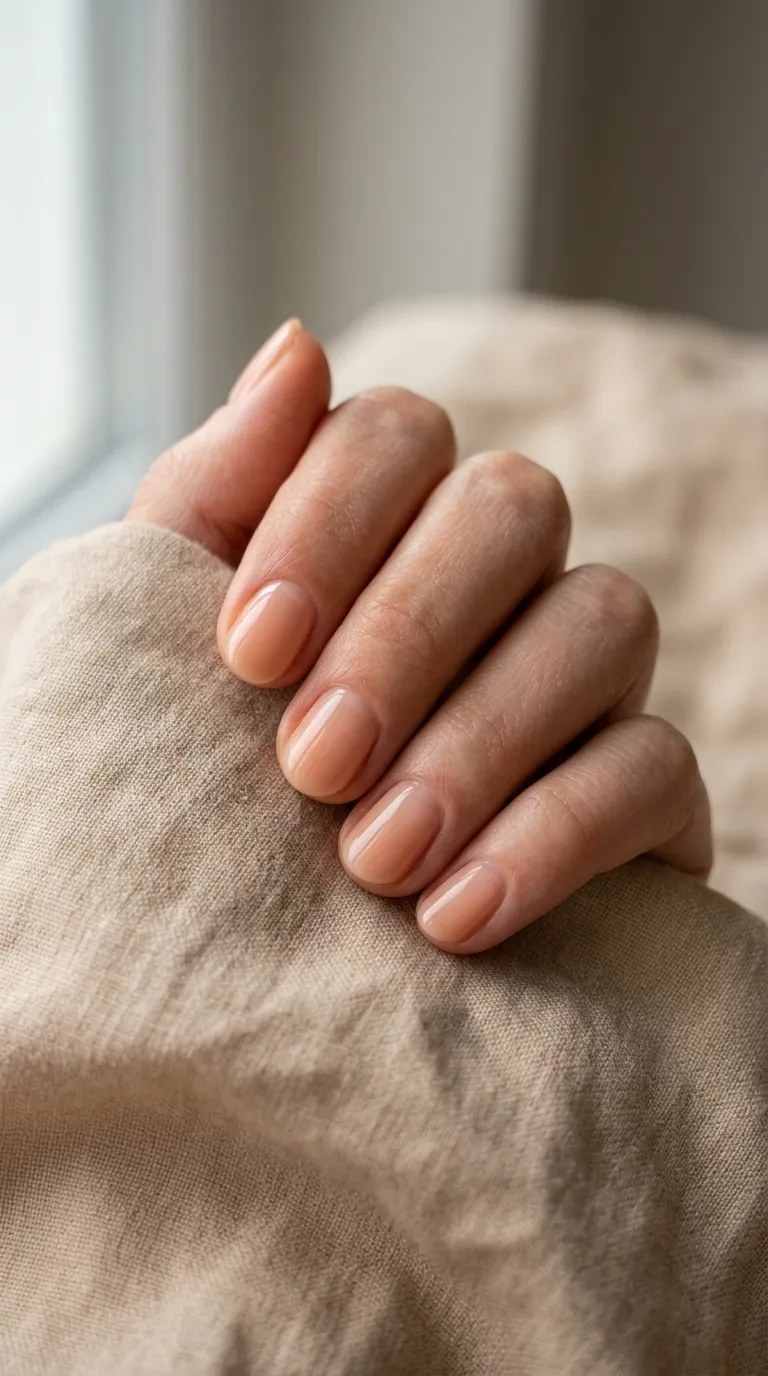
BIAB works with sheer, milky and nude colours, French tips and short, natural-looking shapes. The images below are illustrative design images for inspiration only, not photos of real manicures.
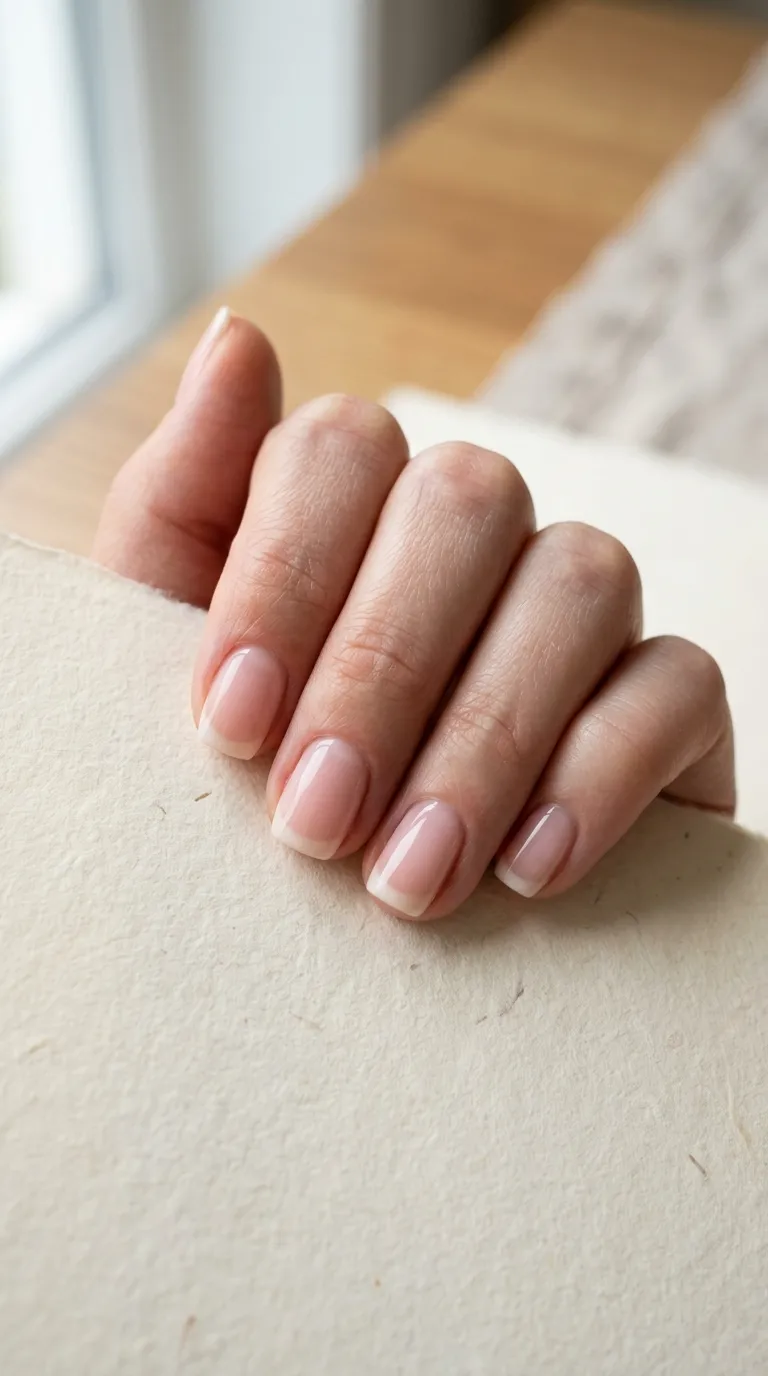
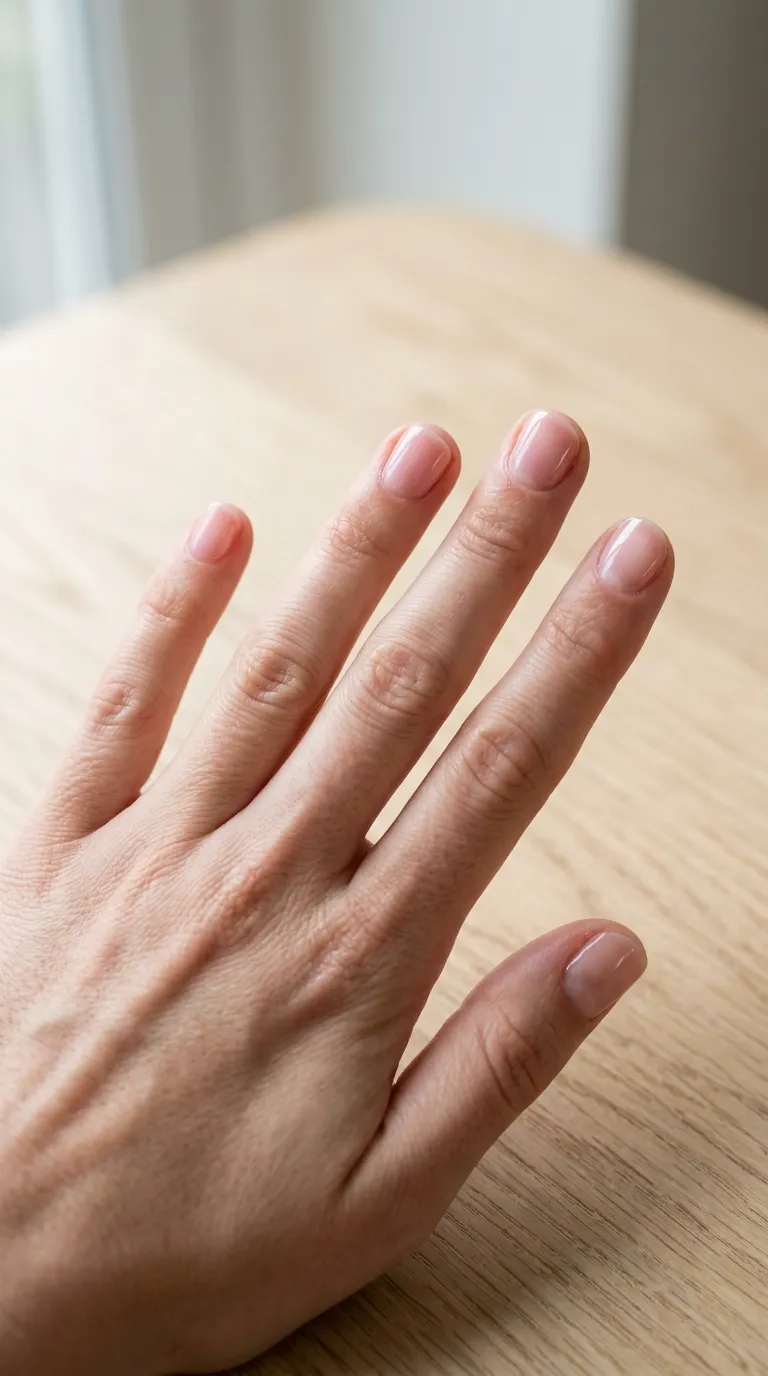
For more ideas, see our milky nails and French tip nails posts.
FAQ
Are BIAB nails better than gel polish?
They do different jobs. Gel polish is mainly cosmetic, while BIAB adds structure to the natural nail. Which is better depends on whether you want colour and shine or strength and growth support.
How long do BIAB nails last?
Published guidance ranges from about three to four weeks, with infills usually booked every two to four weeks. The Gel Bottle itself does not state a wear time on its BIAB page.
Can BIAB nails add length?
Mainly it is an overlay. Some salons sculpt short extensions with nail forms or apply BIAB over tips, but acrylic or hard gel is generally preferred for very long nails.
Is BIAB the same as builder gel?
BIAB is a builder gel, made by The Gel Bottle. The name BIAB is a brand, but it is often used loosely for any builder gel.
Can you do BIAB nails at home?
Home kits exist, but the British Association of Dermatologists warns that at-home use carries extra risk, mainly because under-curing and skin contact with uncured product raise the risk of allergy.
How much is a BIAB infill?
The salons checked above published infills of £30 to £45, with a middle value of £37. Prices are usually higher in London.
Do BIAB nails ruin your natural nails?
Not by itself, according to published guidance. Damage is mostly linked to picking, over-buffing and improper removal, so how it is taken off matters.
NailMoodBoard is an editorial nail-inspiration site, not a salon. This guide summarises manufacturer instructions, dermatology guidance and published salon information.
Sources
- The Gel Bottle: Original BIAB (manufacturer; no wear time stated)
- Treatwell UK: BIAB guide (May 2026)
- Woman and Home: BIAB nails (published 30 October 2024, updated 22 September 2025)
- SheerLuxe: The SL guide to BIAB nails (4 November 2025)
- Salon Searcher: How much are BIAB nails in the UK? 2026 price guide (17 August 2026)
- Apricot Nails: BIAB infill vs new set
- American Academy of Dermatology: Gel manicures, tips for healthy nails
- American Academy of Dermatology: Reducing artificial nail damage
- British Association of Dermatologists: Artificial nails warning and at-home kits (April 2023)
- UK salon price pages checked 3 October 2026: Viet Nail Studio (Aberdeen), Nova Nails (Glasgow), Beauty and Bubbles (Manchester), UK Nails Ealing (London), The Beauty Nest (London), The Nail Bar London (Kingston), Paint Nails London
Diagrams by NailMoodBoard. Design images marked “illustrative” are generated for inspiration and do not show real manicures.
Compare Before You Choose
See the Closest Alternatives
Compare nearby shapes, colors and finishes before picking a final reference.
Recommended Next