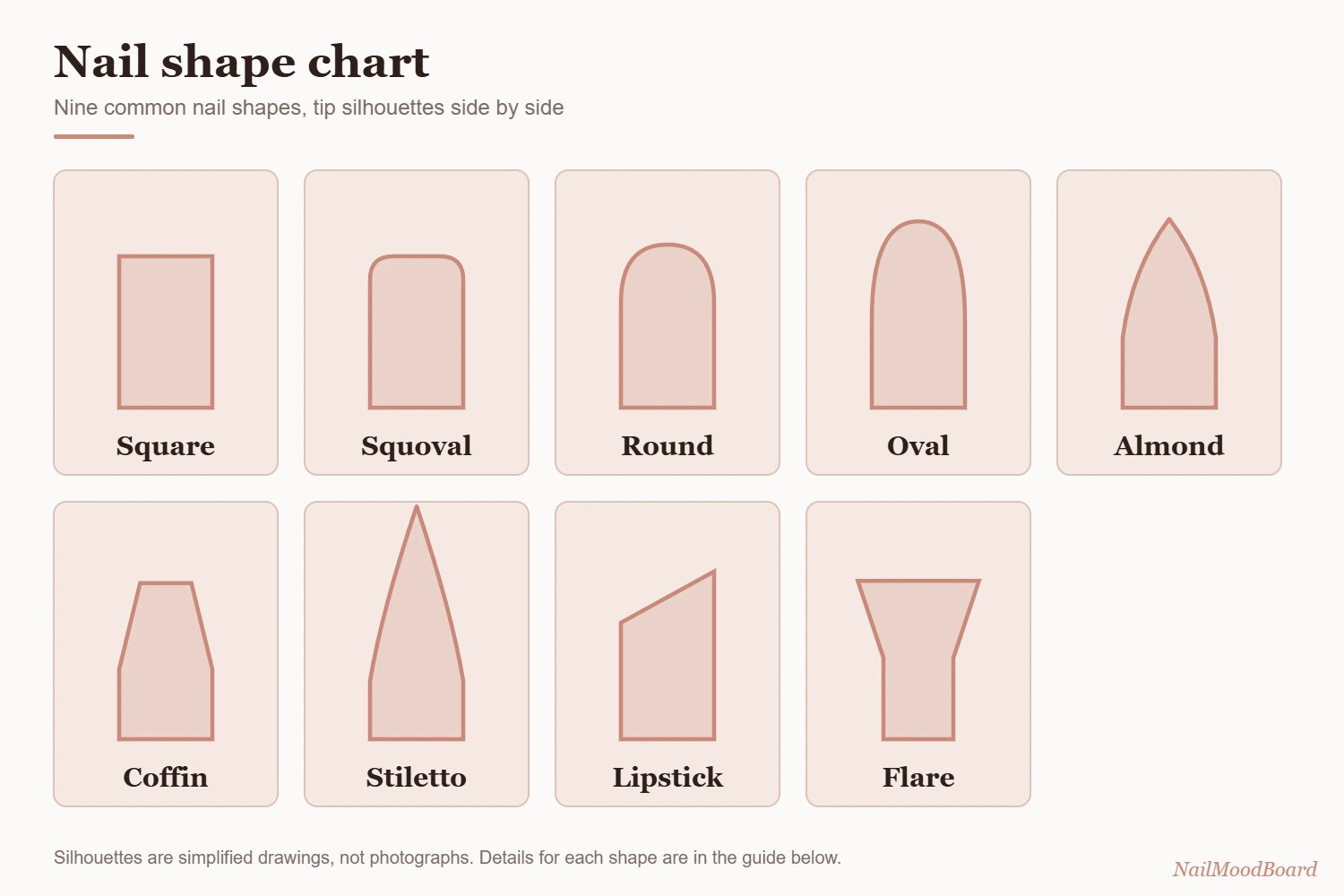
Picking from the many nail shapes is the one decision that changes how every manicure looks, and the names are confusing: squoval, ballerina, lipstick, flare. The chart above puts all nine nail shapes side by side, and the sections below explain what each one looks like, how much length it wants, and whether it suits your hands.
Quick answer: The main nail shapes are square, squoval, round, oval, almond, coffin (ballerina), stiletto, lipstick and flare. Square and squoval are the most practical for short nails. Almond and oval tend to make fingers look longer. Coffin and stiletto usually need length, often with extensions.
Use the chart to narrow it down to two or three nail shapes. Then use the hand table further down to choose between them, and the nail-tech section at the end to describe what you want at the salon.
Nail shapes chart: all 9 side by side
Here is the whole range at a glance. Each line is a one-sentence summary, and the full explanation follows in the next section.
- Square: straight sides, flat tip, defined corners.
- Squoval: square shape with softened corners.
- Round: follows the natural curve of the fingertip.
- Oval: an elongated, smoothly curved tip with no corners.
- Almond: sides taper to a softly rounded point.
- Coffin (ballerina): tapered sides with a flat, squared-off tip.
- Stiletto: a long, sharp, pointed tip.
- Lipstick: a slanted, angled tip.
- Flare: sides that widen toward the tip.
Treat the descriptions of length and durability below as commonly cited guidance, not fixed rules. They come from published beauty and salon guides such as Secret Spa’s nail shape guide and Live That Glow’s nail shape guide, and individual nail techs sometimes disagree. How long a shape lasts also depends heavily on your own nails and how you use your hands.
Every one of the 9 nail shapes explained
Square nails
Square nails have straight sidewalls and a flat free edge, which gives sharp, defined corners. They are usually worn short to medium, and the look is clean and graphic, especially with French tips or bold solid colours. Because the corners stick out, they are more likely to catch on fabric and can snap if your nails are thin. Guides commonly suggest square for strong nails and wider nail beds, and note that it can flatter slim fingers when worn a little longer. For design ideas, see our short square nails and fall square nails posts.
Squoval nails
Squoval is a square nail with the corners rounded off, which is why the name blends “square” and “oval”. It keeps the straight tip of a square but removes the sharp points, so it is widely described as one of the most practical nail shapes. It works on short or medium nails, tends to snag less than square, and grows out neatly. If you are unsure which shape to pick, squoval is the usual low-risk starting point because it suits almost every nail bed.
Round nails
Round nails follow the natural curve of your fingertip, so the free edge is cut short and shaped into a simple arc. It is the shape most often described as low maintenance and the least likely to chip, crack or snag, which makes it popular for people who type a lot or work with their hands. Guides commonly pair it with narrow or small nail beds. The trade-off is that round nails do little to lengthen the fingers, so the look is soft and understated rather than dramatic.
Oval nails
Oval nails are rounded like a rounded-off egg: longer than a round nail, with a smooth curve and no corners. They are usually shown at medium length. Oval is often described as universally flattering, and it is commonly suggested for wider nail beds because the curved sides visually narrow the nail. Nothing sticks out, so oval nails are comfortable to wear day to day, and they suit classic French manicures and sheer, glossy colours particularly well.
Almond nails
Almond nails taper from the sides to a softly rounded tip, like the nut they are named after. They are usually worn at medium to long length, and the taper is the reason almond is so often credited with making fingers and short hands look longer and slimmer. They are more delicate than oval or squoval at the tip, but less fragile than stiletto. Length, filing and design ideas are covered in detail in the almond nails guide.
Coffin (ballerina) nails
Coffin nails have sidewalls that taper inward and a flat, squared-off tip. They are normally worn long, and they are among the most recognisable nail shapes in nail art because the flat tip leaves a wide canvas for designs. The same strengths create the weakness: a long, narrow free edge breaks easily if your natural nails are thin, which is why coffin nail shapes are so often built on extensions. Most guides treat “coffin” and “ballerina” as the same shape. A few describe ballerina as the slightly softer-cornered version.
Stiletto nails
Stiletto nails are long and taper to a sharp point. They are the most dramatic shape on the chart and the hardest to live with: the thin tip is fragile, and everyday tasks such as opening packaging or typing become awkward. They are typically built on extensions rather than natural nails, and the point is usually softened slightly for wearability. If this is the look you want, our long stiletto nails guide, short stiletto nails and stiletto nail art ideas go deeper.
Lipstick nails
Lipstick nails are cut at an angle across the tip, so the free edge slopes like the end of a lipstick bullet. The shape is asymmetrical, which makes it a favourite for fashion-led and editorial manicures, especially with colour-blocking. It is typically worn at medium to long length, and because the angled point is delicate, it is commonly built on extensions or very strong natural nails. Expect to explain it to your nail tech with a photo, since the angle and direction vary a lot.
Flare nails
Flare nails, sometimes called duck nails, do the opposite of almond and coffin: they widen toward the tip, forming a fan or bell shape. They are a statement shape, normally worn medium to long, and they need structural support, so they are almost always done on extensions. Because flare is newer to the mainstream than the others, descriptions vary between salons. Bring a reference photo and agree how wide the flare should be before the set is shaped.
Shape guide table
| Shape | Look | Best length | Durability (commonly cited) | Upkeep | Good for |
|---|---|---|---|---|---|
| Square | Straight sides, flat tip, sharp corners | Short to medium | Strong across the tip, corners can catch and snap | Medium | Strong, flat or wide nail beds |
| Squoval | Square with softened corners | Short to medium | High | Low | Almost all nail types, daily wear |
| Round | Follows the fingertip curve | Short | High | Low | Narrow nail beds, typing, active hands |
| Oval | Elongated, smooth curve | Medium | Moderate to high | Low to medium | Wider nail beds, classic looks |
| Almond | Tapered, softly rounded tip | Medium to long | Moderate | Medium | Narrow nail beds, longer-looking fingers |
| Coffin / ballerina | Tapered sides, flat tip | Medium to long | Lower on thin natural nails | High | Strong nails or extensions, nail art |
| Stiletto | Long sharp point | Long | Fragile | High | Extensions, statement looks |
| Lipstick | Slanted, angled tip | Medium to long | Delicate at the point | High | Strong nails or extensions, fashion looks |
| Flare | Widens toward the tip | Medium to long | Needs structural support | High | Extensions, bold nail art |
Which nail shapes suit your hands?
There is no single correct answer, because nail bed width, finger length and daily habits all matter. The table below summarises what published guides commonly recommend for common hand traits. Treat it as a starting point and judge by how a shape looks and feels on your own hands.
| Hand trait | Shapes often recommended | Why |
|---|---|---|
| Short fingers | Almond, oval, longer squoval | Tapered or curved tips create a lengthening line |
| Long fingers | Squoval, round, square | Flatter tips balance the length instead of adding to it |
| Wide nail beds | Oval, squoval, coffin | Curved or tapered sides visually narrow the nail |
| Narrow nail beds | Round, almond | Soft nail shapes follow the narrow bed without looking pinched |
| Weak or peeling nails | Short round, short squoval | Fewer corners and a short free edge give less to snag |
| Active hands or lots of typing | Round, squoval, short oval | Rounded edges are less likely to catch or break |
Two of our longer posts handle the details. Best nail shapes for short fingers covers nail-bed types and filing in depth, and best nail shape for older hands covers shapes and colours for mature hands.
Best nail shapes for short nails
Short nails look best in nail shapes that keep the free edge simple: round, squoval, short square or short oval. Short almond works too if the taper is gentle, because even a small taper creates a lengthening line. For the full breakdown, including how to file each one, read the short fingers guide.
Best nail shapes for weak or breaking nails
Rounded nail shapes are commonly recommended for weak or breaking nails, because a curved free edge has no corners to catch on fabric and a shorter length gives the nail less leverage to snap. Round and squoval are the usual picks. Very long, narrow nail shapes such as stiletto, coffin and lipstick put the most stress on thin nails, which is why they are usually built on extensions instead of natural nails. If your nails split or peel often, a short, rounded shape gives them the best chance to grow out.
Coffin vs almond vs stiletto
These three get compared constantly because all taper toward the tip, but they behave very differently on real hands.
| Coffin | Almond | Stiletto | |
|---|---|---|---|
| Tip | Flat, squared off | Softly rounded point | Sharp point |
| Typical length | Medium to long | Medium to long | Long |
| Everyday wear | Moderate, depends on nail strength | Easier | Hardest |
| Best for | Nail art on a wide, flat tip | Lengthening, softer drama | High-fashion statement looks |
If you want the tapered look but also need to use your hands, almond is the most forgiving of the three. Coffin gives more space for art. Stiletto is the one to choose only if you are happy to adapt your routine around it.
Nail shapes for acrylic and extensions
Natural nails can usually be filed into round, squoval, square and oval, as long as there is enough free edge. Almond is possible on medium-length natural nails. The long, narrow shapes, meaning coffin, stiletto, lipstick and flare, generally need extensions, because most natural nails will not grow that length strong enough to hold the shape. Extensions can be acrylic, hard gel, or soft-gel tips. If you are weighing options, our Gel X nails guide explains one popular tip-based system, including cost and wear time. Acrylic nail shapes are shaped in the same way as the shapes above. What changes is how the length is built.
How to ask your nail tech for the right nail shapes
Nail shape names are not fully standardised, so the clearest request combines a name, a length and a photo. Nail techs commonly use these terms:
- Free edge: the part of the nail that extends past your fingertip.
- Sidewalls: the sides of the nail. Tapered sidewalls make almond, coffin and stiletto.
- Taper: how quickly the sides narrow toward the tip.
- Soft corners: squared edges rounded slightly, which is what makes squoval.
- Length reference: short, medium and long are usually described relative to your fingertip, so say whether you want the nail to stop at the tip, just past it, or well past it.
Then do three simple things. Bring a photo of the shape you want, ideally from more than one angle. Ask whether your natural nails can support that shape or whether it needs extensions. And say how you use your hands, so your tech can suggest a stronger variation if needed.
FAQ
Which nail shapes are the most popular?
There is no reliable public ranking, so any “number one” claim should be treated with caution. Almond and squoval are widely recommended in published guides because they flatter many nail types and are practical to wear.
What shape makes fingers look longer?
Oval and almond are the shapes most often credited with lengthening the fingers, because the curved or tapered tip draws the eye along the finger line.
What’s the difference between coffin and ballerina nails?
Most guides use the two names for the same tapered shape with a flat tip. A few describe ballerina as the version with slightly softer corners.
What is the difference between squoval and oval?
Squoval keeps a straight, squared tip and only rounds the corners. Oval has a fully curved tip with no straight edge.
What shape is strongest?
Rounded shapes such as round and squoval are commonly considered the least prone to snagging and breaking, especially at short length. Strength also depends on your natural nail thickness and how you use your hands.
Can short nails be almond?
Yes. A short almond uses a gentle taper and a rounded tip, and it can still create a lengthening effect.
NailMoodBoard is an editorial nail-inspiration site, not a salon. This guide summarises manufacturer instructions, dermatology guidance and published salon information.
Sources
- Secret Spa: The ultimate guide to the different nail shapes (UK salon guide, March 2022)
- Live That Glow: Nail shape guide (beauty publication, November 2025)
Diagrams by NailMoodBoard. Design images marked “illustrative” are generated for inspiration and do not show real manicures.
Compare Before You Choose
See the Closest Alternatives
Compare nearby shapes, colors and finishes before picking a final reference.
Recommended Next
Mismatched Nails 2026: 50+ Mix and Match Ideas That Actually Look Good
Read the guide →